

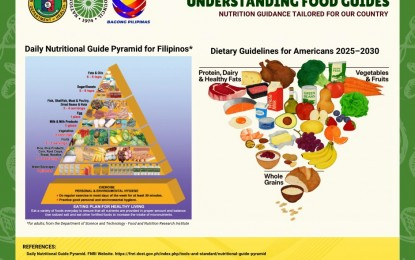
MANILA – The National Nutrition Council (NNC) on Wednesday acknowledged the release of the United States Dietary Guidelines for Americans 2025–2030, while reminding the public that the Philippines will continue to follow its own locally developed dietary tools anchored on Filipino food culture and nutrition data.
The new guidelines jointly issued by the United States Department of Health and Human Services and the Department of Agriculture emphasize the consumption of nutrient-dense foods and the limitation of highly processed products.
The recommendations were presented through an inverted food pyramid highlighting protein, dairy, vegetables, fruits, healthy fats, and whole grains.
The NNC, in a statement, said that while international guidelines offer useful insights for public health and nutrition practitioners, the Philippines remains guided by the Daily Nutritional Guide Pyramid developed by the Department of Science and Technology–Food and Nutrition Research Institute (DOST-FNRI).
The council noted that both the US dietary guidelines and the Philippine guide promote healthy eating, increased physical activity, and the reduction of refined sugars, fatty and salty foods, and alcoholic beverages.
However, the NNC pointed out that the US guidelines place stronger emphasis on specific food groups such as protein and dairy, while the Philippine Daily Nutritional Guide Pyramid highlights the consumption of whole and fresh foods, guided by the core principles of balance, variety, and moderation.
The NNC reaffirmed its commitment to advancing nutrition policies and programs that are evidence-based, culturally appropriate, and responsive to the needs of Filipinos.
It said local dietary tools, grounded in Philippine research and food traditions, remain the most suitable foundation for promoting healthy eating among Filipinos.
By continuing to promote the Daily Nutritional Guide Pyramid, Pinggang Pinoy, and the 10 Kumainments, the NNC underscored its goal of strengthening nutrition as a pillar of public health and national development.
The council said these locally developed tools collectively guide balanced meals, proper food portions, adequate hydration, and an active lifestyle, underscoring the importance of grounding nutrition advice on Philippine data, food habits, and public health needs. (PNA)