

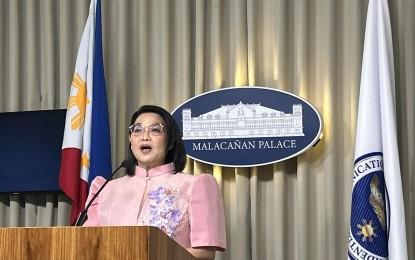
MANILA – Malacañang on Wednesday assured the public that the government is ramping up its response efforts as the country braces for the possible effects of a strong El Niño phenomenon.
Speaking to Palace reporters, Presidential Communications Office Undersecretary Claire Castro said the government is closely monitoring El Niño conditions, particularly its potential impact on agriculture, water resources and other vital sectors.
Castro acknowledged that while El Niño is a natural climate phenomenon, its effects could become more severe due to climate change.
“Sa nararamdaman po nating climate change at kailangang pag-aralan din po dahil sa climate change kung ano ba ang maaari pang maging matinding idudulot ng El Niño maliban sa ito ay nagiging normal naman talaga, normal na nararamdaman natin (Given the climate change we are experiencing, we also need to study the potentially more severe effects that El Niño could bring, although it is already a natural phenomenon that we normally experience),” she said.
“Pero dahil sa climate change, baka mas matindi ang maramdaman at magiging epekto ng El Niño (But because of climate change, the effects of El Niño could be more severe and more strongly felt),” Castro added.
Castro said the Department of Agriculture has already activated the El Niño Task Force to respond to the phenomenon.
She noted that weather conditions vary across the country, with some areas experiencing heavy rains while others are facing dry conditions.
“Kinakailangan po talaga ng sapat na pagpiprepara, kaya ito po ay minu-monitor, patuloy po na monitoring ng El Niño conditions at ang pagprotekta lalung-lalo na sa ating mga magsasaka at, kumbaga, sa ating mga agricultural products na talagang maaapektuhan ng El Niño (Adequate preparation is really necessary, which is why we are closely monitoring the El Niño conditions and taking steps to protect, particularly, our farmers and agricultural products that could be significantly affected by El Niño),” she said.
Castro said the government is also working to manage irrigation and water resources, with the National Irrigation Administration (NIA) preparing to help farmers cope with changing weather conditions.
She said farmers are being provided with guidance on crop selection and timing of planting and harvesting to minimize the impact of extreme weather on agricultural production.
“Inaalam po nila [NIA] at binigyan po nila ng aral or lessons, techniques ang ating mga magsasaka kung ano ba ‘yung mga dapat na itanim kapag malakas ang ulan o kailan dapat sila umani para hindi naaapektuhan ang kanilang mga ani ng bagyo. So, dapat may mga produkto rin po na dapat na maitanim kahit na tag-ulan (They are also studying the situation and providing our farmers with lessons and techniques on what crops to plant during heavy rains and when to harvest so their crops will not be affected by storms. So, there should also be crops that can be planted during the rainy season),” Castro said.
Asked whether existing measures are sufficient amid projections that the El Niño phenomenon could become very strong, Castro said the government continues to pursue measures to address climate change, which could worsen the effects of extreme weather events.
The World Meteorological Organization (WMO) has issued a significant update on El Niño, forecasting a very strong event that is expected to persist through February 2027.
The phenomenon is expected to lead to an increased risk of extreme weather, including floods, droughts, and extreme heat, affecting various sectors such as agriculture, health and water resources.
WMO emphasized the need for exceptional preparation and response from governments and decision-makers, highlighting the urgency of mobilizing resources to mitigate the impact of El Niño. (PNA)