

MANILA – The Department of Environment and Natural Resources (DENR) is intensifying efforts to address water security, flooding, and deforestation, amid President Ferdinand R. Marcos Jr.’s call for a climate-resilient future and sustainable development.
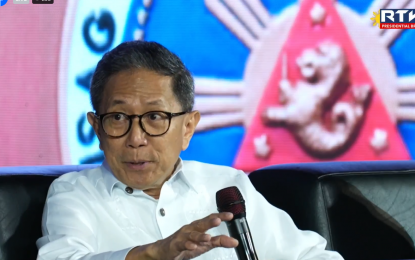
At the post-State of the Nation Address (SONA) conference on Tuesday, Environment Secretary Raphael Lotilla cited government data stating that an estimated 40 million Filipinos nationwide still lack access to safe and clean water sources.
He admitted that this is a challenge that the DENR, together with other concerned agencies, is working to address through various approaches, including the implementation of clean water systems, rainwater harvesting, reforestation, and even hazard mapping.
In his SONA, the President touted modern technology in water management, including a systemic process to produce clean water, especially in remote areas and islands.
Lotilla said that in 2024, six filtration and desalination systems were installed, while 28 more are expected to be operational by 2025.
All these aim to bring potable water infrastructure to isolated communities, he said.
“Ang gusto natin ay mapabuti ang water services kahit sa mga liblib na lugar. Through filtration and desalination, kahit dagat ang source, pwede nang gawing inumin ang tubig (What we want is to improve water services even in remote areas. Through filtration and desalination, even if the source is the sea, water can be made drinkable),” he said.
Meanwhile, Lotilla also emphasized the importance of rainwater catchment systems, backing Marcos’ call to institutionalize water storage as a standard feature in urban planning.
Lotilla cited the Bonifacio Global City (BGC) in Taguig City as a successful model, where underground cisterns have helped prevent flooding.
He said the DENR is coordinating with the Department of Human Settlements and Urban Development (DHSUD) to integrate cistern requirements or incentives into subdivision and housing development policies.
“Pinag-uusapan namin ni Secretary Ping Aliling ng housing natin na magkakaroon tayo ng polisiya para bigyan natin ng requirement or incentives yung mga subdivision developers, yung mga housing developers, na meron na silang cisterns para ito mag-store ng tubig. Ang tubig pwede nilang magamit during the difficult periods (I and Secretary Ping Aliling are already in talks about having a policy on giving requirements or incentives to the subdivision developers, the housing developers, for them to have cisterns to store water. They can use the water during the difficult periods),” he said.
He even cited golf courses, which have the potential to hold water, adding that the country has so many potential areas to store water, even temporarily.
Lotilla added that the Marcos administration is pushing for a holistic strategy that aligns flood control with long-term water storage for agriculture, energy, and household use, citing dams, which he said, were not built for flood control but are used to store excess water for dry seasons.
He also noted that the Groundwater Atlas, which is accessible to the public, identifies available water sources nationwide, including surface and underground reserves.
On reforestation efforts, meanwhile, he noted an increase in forest cover, as DENR plans to double the national tree-planting target from 5 million to 10 million trees by 2028 through partnerships with the private sector.
Meanwhile, on the recent flooding and landslides caused by typhoons and monsoon rains, Lotilla reminded local governments of the availability of accessible hazard maps like the HazardHunterPH, the geo-hazard mapping of the DENR’s Mines and Geosciences Bureau (MGB).
He said the MGB prepares two- to three-day forecasts of landslide- and flood-prone areas to help local government units prepare for climate-related disasters, based on PAGASA data.
“Hindi natin maiiwasan lahat ng sakuna, pero makakapaghanda tayo. Kahit mga pamilya, dapat tingnan kung ang lugar nila ay may hazard (We can’t avoid disasters, but we can prepare. Even families should check hazards in their areas),” Lotilla added.
He urged property developers and buyers to avoid constructing in danger zones and to consult DENR data before acquiring land.
Waste management, flooding
On the issue of solid waste, Lotilla said the flooding in Metro Manila was mainly due to clogged drainage systems caused by uncollected garbage.
Regular “spring cleaning” ahead of the rainy season is important, he said, calling for stronger collaboration with the Department of Local Government (DILG) and the Metropolitan Manila Development Authority (MMDA).
Lotilla also urged households to segregate waste. (PNA)